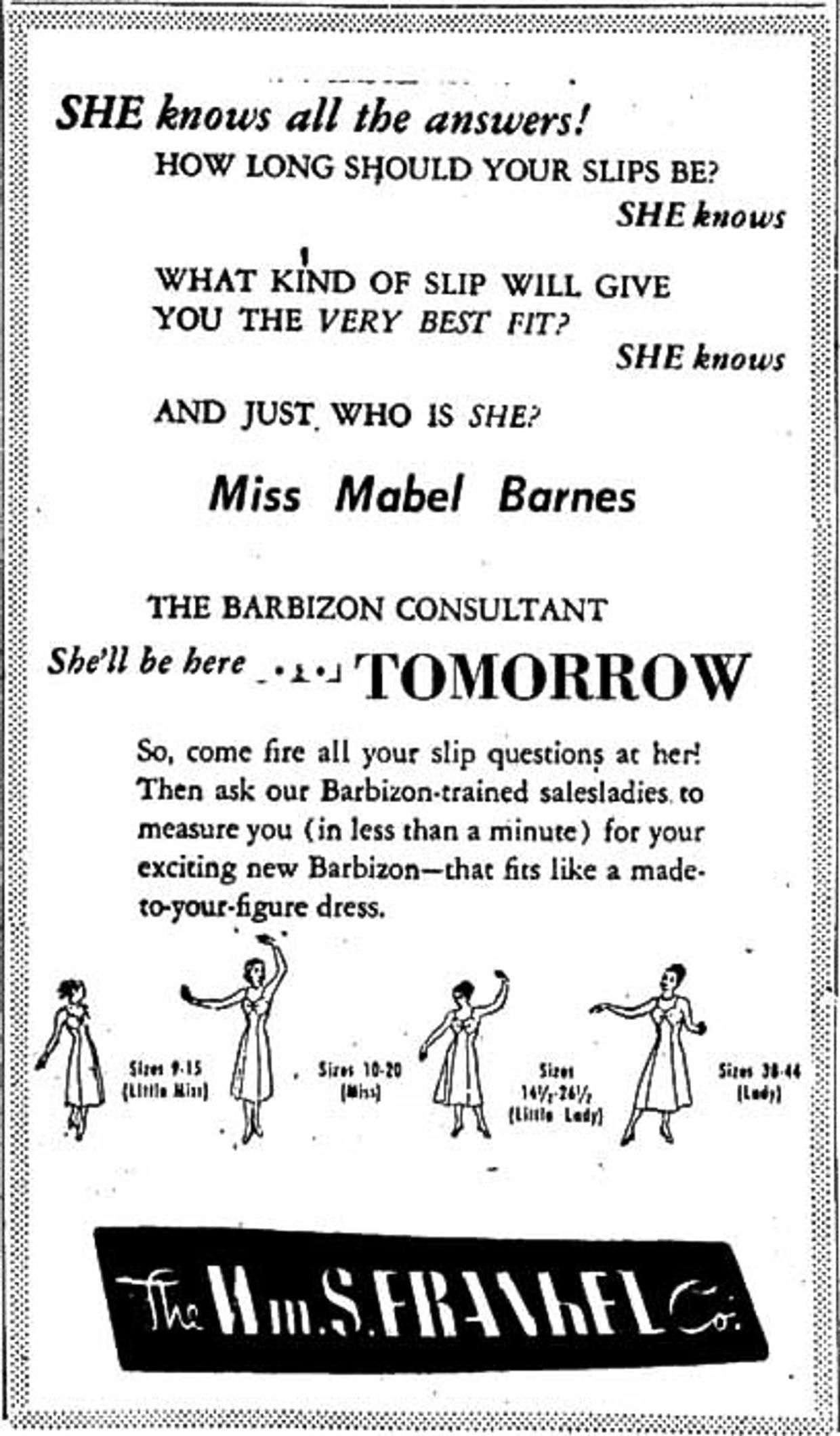
This is the most comprehensive and detailed label dating resource for vintage Barbizon full and half slips available. When were Barbizon slips made? Find how to date vintage Barbizon lingerie here. Information includes slip name, fabric used, fabric first use date and earliest known appearance in advertising. Rayon fabric slips of the 1940's can be difficult to date but the advertising information shown in the tables below can help with researching your vintage Barbizon lingerie.
The history of Barbizon, one of the world's finest manufacturers of lingerie, really started in 1917 when three young men - Harry Garfinkel, along with Gerald and George Ritter went into partnership to make silk lingerie. This brave new venture, called Garfinkel & Ritter, worked out of a cramped New York loft with just 12 sewing machines. From an initial capital outlay of just $7500 these three enterprising men had turned over $125,000 in their first year.
Then, in April 1929, Messrs Garfinkel and Ritter rented a small plant and began to weave their own silk fabric under the name of Jaunty Silk Co., Inc. They had registered the trademark 'Jaunty' in 1925 in preparation for this venture. This was the start of Barbizon's unique method of weaving, dyeing and finishing its own lingerie fabrics under what was later, after 1957, to become known as the Jaunty Fabric Corporation.
Established in 1933 and rapidly becoming one of the most respected slip manufacturers of all time, with it's head office in New York Barbizon also had a fabric weaving mill in Scranton, Pennsylvania which gave it the distinction of also manufacturing the fabrics from which they made their lingerie and giving each fabric a very exotic-sounding name. Barbizon's beautifully made lingerie was made in their plant in Provo, Utah from 1946 (originally with just one sewing machine!) after taking over the old and near-derelict Knight Woollen Mill before moving to a newly built 6-acre state-of-the-art factory at 150 W.12th North Street in 1951. The company also owned additional lingerie sewing plants in Scranton, Pennsylvania and Paterson, New Jersey. By 1972 Barbizon's Provo plant alone employed around 450 people and around 900 people in total across the United States.
Seemingly, there was little place for traditional glamour in 80s clothing and this had a direct impact on the wellbeing of the company. From their initial success, Barbizon's fortunes had completely turned round by the summer of 1980 due to the harsh economic conditions of the time and unfortunately their plant at Provo, Utah had to close with the loss of 320 jobs. A proposed buyout afterwards by a group of ex-employees unfortunately failed too.
Sadly, Barbizon's time as an independent maker of fine lingerie at the pinnacle of 1950s fashion in America finally came to an end when the Barbizon Corporation and Barbizon Lingerie Co.,Inc was sold out to Vanity Fair (VF Corporation) in June 1991.